Near Wells in Somerset, a river runs through a cave where, legend has it, a monk once turned a witch to stone. Couples get married down there. In Manchester they marry beneath the wings of Concorde. In Plymouth they climb 93 steps, most of them ladders, to the lantern room of a lighthouse that spent more than a century out on a reef in the sea.
Every one of these places sits on the same official list as the country-house hotels and the converted barns: more than 7,300 venues in England and Wales approved by their council to hold a civil wedding or civil partnership. Most of them are what you would picture. This is a tour of the rest, the caves and lighthouses, warships and steam railways, a jail, a racing circuit and a planetarium, and each name below links to its area page, where it sits among everything else licensed nearby.
Underground
At Wookey Hole Caves, the River Axe runs through limestone caverns that Neanderthals and modern humans have used for around 45,000 years. The caves hold a steady 11°C, which is why Cheddar is matured in one of the tunnels. Ceremonies take place in a choice of three chambers, for two guests or for 300, with the lighting changed to match your colours.
In 1927, excavators at Kents Cavern in Torquay found a fragment of a human upper jawbone that has since been dated to more than 41,000 years old. The cave system is a Scheduled Ancient Monument, and it offers five separate underground spots for a civil ceremony, from late afternoon, seven days a week.
Carnglaze Caverns, near St Neot in Cornwall, were dug by slate miners rather than carved by water. During the Second World War the Royal Navy stored its rum in the largest chamber, still called the Rum Store, which now seats 400. Further down, couples marry by candlelight beside a clear underground lake: the same water that appears on the cover of Echo & the Bunnymen’s album Ocean Rain.
In the Black Country, Dudley Canal and Caverns sends narrowboats into the canal tunnel that was dug to reach the limestone mines beneath Castle Hill and Wren’s Nest, the second-longest canal tunnel on the UK network today. Alongside a canal-side room and a narrowboat to charter, the trust offers couples an underground ceremony.
Sixty feet below Uxbridge, at the bottom of 76 steps, is the operations room from which No. 11 Group of Fighter Command controlled its squadrons. On 15 September 1940 Winston Churchill watched there as every one of the group’s squadrons was engaged at once. At the Battle of Britain Bunker, ceremonies take place in the modern visitor centre above ground, and guests can be taken below for a private tour of the bunker.
Cut into the cliffs
In 1782 a lead miner from Allendale called Jack Bates used explosives from a nearby quarry to blast a cave in the cliffs at Marsden Bay into a much larger one, and earned the name Jack the Blaster. His home became Marsden Grotto, a pub reached by a lift down the cliff since 1938 and one of the very few cave bars in Europe. Weddings run from October to April in its licensed cave, with bedrooms on site for the night.
Clifton Observatory began in 1766 as a windmill for corn on the cliffs above the Avon Gorge in Bristol. In 1828 the artist William West took it over, installed a camera obscura that has been there ever since, and then had a tunnel dug through the rock to a cave that opens 250 feet above the floor of the gorge. That cave, the Giant’s Cave, is licensed for ceremonies, with room for about 20 guests standing on its balcony, looking across to the Clifton Suspension Bridge.
Lighthouses
Smeaton’s Tower stood on the Eddystone reef from 1759 until 1877, when the rock beneath it was found to be eroding. Its upper part was taken down and rebuilt stone by stone on Plymouth Hoe, while its stump stayed on the reef, too strong to dismantle. The lantern room at the top is licensed for ceremonies of up to nine people.
The Old Lighthouse at Dungeness opened in 1904 and was decommissioned in 1960, after the building of Dungeness nuclear power station blocked its light and a new lighthouse took over. It is 169 steps to the top. Ceremonies can be held on any floor, with up to 30 guests on the bridge level or ten on the gallery.
St Mary’s Lighthouse, built in 1898 near Whitley Bay, stands on a tidal island joined to the mainland by a short concrete causeway that disappears under the sea at high tide. Switched off in 1984, it is now a visitor centre, licensed for ceremonies of up to 46 guests. Check the tide table before you choose your time.
West Usk Lighthouse was built in 1821 by the engineer James Walker where the Usk meets the Severn estuary, near Newport. It stopped working as a lighthouse in 1922, is now a hotel, and turned up in a 2020 episode of Doctor Who. It has held weddings since 2012, with intimate ceremonies in the entrance hall and larger ones in a marquee overlooking the water.
Piers and a tower
Bangor Garth Pier opened in 1896 and runs 1,500 feet out into the Menai Strait, the second-longest pier in Wales. When it faced demolition in the 1970s, Bangor City Council bought it for a nominal penny. Ceremonies are held on the deck, in the Pavilion café or in one of the two lookout kiosks at the far end, and since no cars are allowed on the pier, the couple can travel along it by golf buggy.
The Grand Pier at Weston-super-Mare opened in 1904 and stands a quarter of a mile out to sea. Its pavilion burned down in 2008 and reopened in 2010, rebuilt with an arcade, rides and a go-kart track. Weddings use rooms tucked away from the day-trippers, and at least one couple’s guests ended the day on the rides.
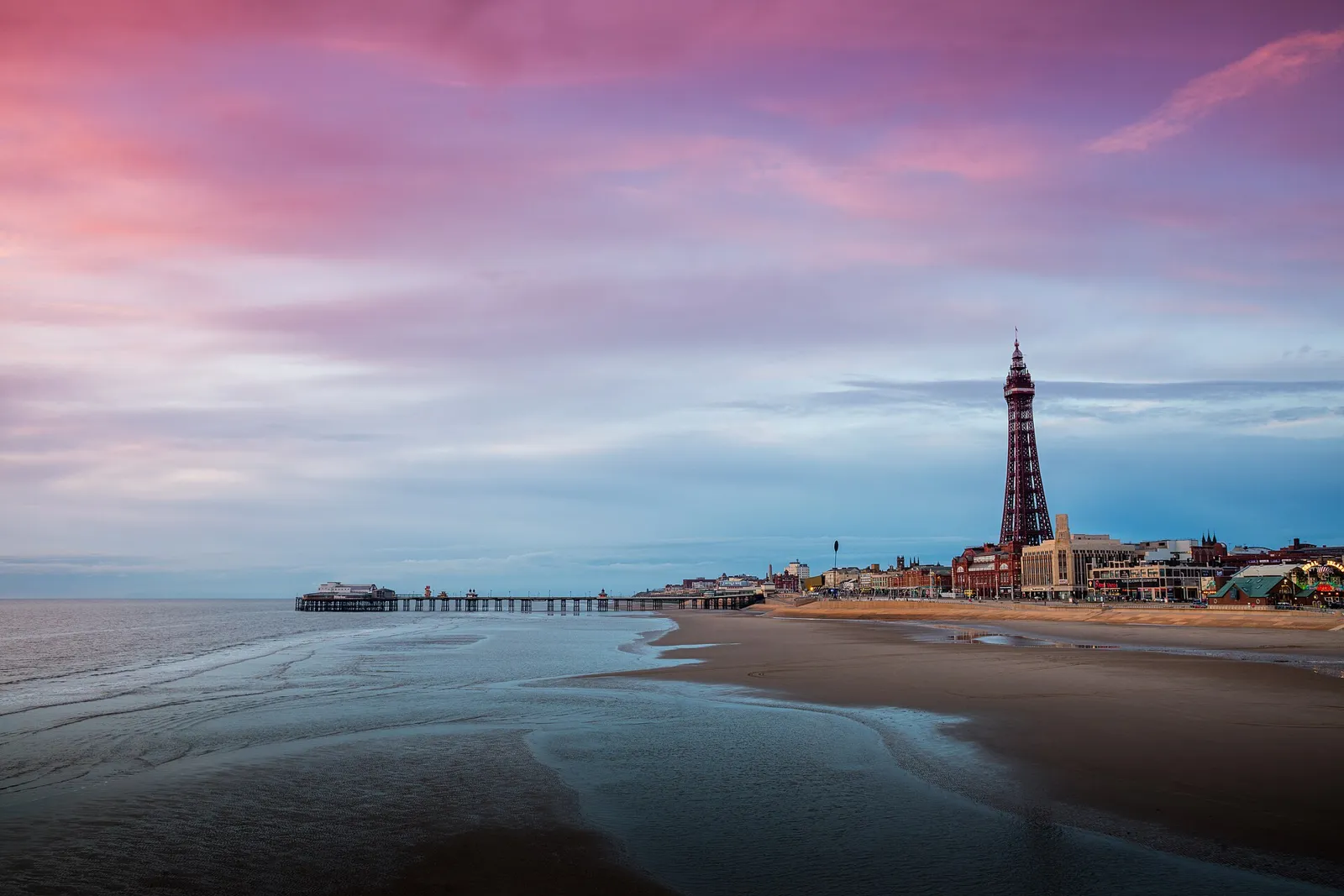
The Blackpool Tower opened in 1894 as the town’s answer to the Eiffel Tower: 518 feet high, with a circus between its four legs that has run since opening day. The Tower Top, 380 feet up, holds a wedding licence, so you can marry while the sun sets over the Irish Sea, and ceremonies also take place in the ornate Tower Ballroom below.
All aboard
Isambard Kingdom Brunel’s SS Great Britain was launched in Bristol in 1843, and in 1845 she became the first iron-hulled steamship to cross the Atlantic. She ended up as a storage hulk in the Falkland Islands, was scuttled there in 1937, and in 1970 was salvaged and brought home to the dry dock where she was built. Ceremonies take place on the Promenade Deck, under a glass skylight, for up to 70 seated guests.
Cutty Sark was built in 1869, one of the last tea clippers, and logged a top speed of 17.5 knots under sail. Since her restoration in 2012 she has sat raised about three metres above her dry dock in Greenwich, so you can walk underneath her. Ceremonies of up to 300 guests are held there, and Royal Museums Greenwich calls it the one place in the world where you can marry beneath the shining hull of a ship.
Moored on the south bank of the Thames, the Golden Hinde is a hand-built reconstruction of the galleon in which Francis Drake sailed around the world between 1577 and 1580. Her keel was laid at a shipyard in Appledore, Devon, in 1971, and couples have married on board since 1999.
HMS Warrior was launched in 1860 as one of Britain’s first armour-plated, iron-hulled warships, then spent fifty years of her retirement as an oil jetty at Pembroke Dock before returning, restored, to Portsmouth in 1987. Couples marry in the Captain’s Cabin or on the Officers’ Half Deck, and the ship’s wedding history goes back to 1863, when she escorted Princess Alexandra of Denmark on her way to marry the future Edward VII.
In Hartlepool, HMS Trincomalee was built of teak in Bombay in 1817 and is the oldest British warship still afloat. The ceremony is held in her wood-panelled Captain’s Cabin, with drinks afterwards on the top deck, looking over the marina.
Speed, sport and supersonic flight
At Manchester Airport, Concorde G-BOAC, once the flagship of the British Airways fleet, sits in its own purpose-built hangar. Ceremonies for up to 600 guests take place underneath its wings, and for an intimate ceremony, you can marry on board the aircraft itself.
Brands Hatch in Kent began as a grassy hollow shaped like an amphitheatre, where cyclists and then motorcyclists raced across farmland. Cars arrived in 1950, and the circuit hosted the British Grand Prix twelve times between 1964 and 1986. It now holds wedding ceremonies in its purpose-built buildings at the circuit.
Malcolm Campbell set the world land speed record on Pendine Sands in Carmarthenshire in 1924, at 146 miles an hour. Three years later the Welsh driver J. G. Parry-Thomas was killed there when his car, Babs, crashed during a record attempt; Babs was buried in the dunes and dug up in 1969. The restored car is back in Pendine at the Museum of Land Speed, which has two licensed ceremony rooms and floor-to-ceiling windows over the sands.
Anfield opened in 1884 as the home of Everton, not Liverpool. After a dispute with John Houlding, Everton left for Goodison Park in 1892, and Houlding founded a new club, Liverpool FC, to fill the empty ground. The club now hosts weddings and civil partnerships in the stadium.
Steam, water and wind
The Bluebell Railway in Sussex reopened in 1960 as the world’s first preserved standard-gauge steam railway to run a regular public timetable. Couples marry in the waiting room on the platform at Horsted Keynes, then board a private dining train, hauled by a steam engine, for the wedding breakfast.
The Talyllyn Railway was built in 1865 to carry slate down to Tywyn, and in 1951 it became the first railway in the world to be saved by volunteers. One of them was the Reverend W. Awdry, who wrote it into the Railway Series, the books behind Thomas & Friends, as the Skarloey Railway. Wedding parties of up to forty ride a special train from Tywyn Wharf on the 45-minute journey to Abergynolwyn station, where the ceremony is held.
Papplewick Pumping Station was built between 1881 and 1884 to pump drinking water to Nottingham. Its Gothic Revival engine house has stained-glass windows and decorative cast iron around two beam engines from James Watt & Co. Ceremonies take place on the mezzanine above the engines, for about 30 seated guests with more standing on the engine floor below, from April to mid-October.
Cley Windmill, at Cley-next-the-Sea in Norfolk, was advertised as newly built in 1819, stopped milling around 1912 and became a holiday home in 1921. It has since appeared in a BBC television ident, and today it is a guest house holding ceremonies for up to 50 guests, with beds for 22 of them afterwards.
Forts and a Victorian castle
Fort Belan was built in 1775 by Thomas Wynn, later Lord Newborough, who feared for the coast during the American War of Independence. It guards a channel 115 feet wide at the south-western entrance to the Menai Strait, and it is the one purpose-built fort of that war on this side of the Atlantic. Its music room is licensed for ceremonies of up to 120 guests.
Nothe Fort in Weymouth was built between 1860 and 1872 to guard Portland Harbour, and saw no action until the Second World War, when it became an anti-aircraft position. Couples marry on its North Terrace, looking out along the Jurassic Coast, or inside a Victorian casemate beside a 64-pounder cannon.
Peckforton Castle in Cheshire has a gatehouse, a portcullis, a dry moat and arrow slits, but it was built between 1844 and 1850, as a country house for the landowner and MP John Tollemache. It has been a film set, including for a 1991 Robin Hood film, and it now has five rooms licensed for ceremonies.
Cells and courtrooms
Bodmin Jail was built in 1779 by prisoners of war and was the first British prison to hold its inmates in individual cells. More than 50 people were publicly hanged there, and at the end of the First World War it kept the Domesday Book safe. It closed in 1927, reopened as a hotel in 2021 with a stay package called Cellblock and Breakfast, and now takes exclusive-use weddings.
The Norman baron Robert D’Oyly began Oxford Castle in 1071, and in 1142 the Empress Matilda escaped it during a siege; legend has her waiting for the river to freeze, then slipping through the enemy lines at night dressed in white. The site was a prison until 1996. Since 2005, Malmaison Oxford has used the old cells as bedrooms, and it holds weddings and civil ceremonies.
In Presteigne, the Judge’s Lodging was completed in 1829 as the Shire Hall for Radnorshire, with a courtroom, prison cells and an apartment for the visiting judge; the last magistrates’ court sat there in 1990. It is now a museum with three restored rooms registered for ceremonies, and as the museum puts it, you can even get married in court.
Among the animals
London Zoo in Regent’s Park opened in 1828 as the world’s oldest scientific zoo, although the public were not let in until 1847. Its landmarks include Berthold Lubetkin’s 1930s Penguin Pool, listed Grade I. Ceremonies are held in the Prince Albert Suite, in a Georgian building, or in the Mappin Pavilion, and summer evening receptions can be held at Penguin Beach.
In 2006 Benjamin Mee and his family bought a struggling wildlife park in Devon, and his memoir of the experience became the 2011 film We Bought a Zoo, starring Matt Damon and Scarlett Johansson. Dartmoor Zoo now holds ceremonies in a room with its original wooden floor and fireplace, or in summer marquees among the enclosures, with animal encounters for the wedding party afterwards.
Yorkshire Wildlife Park opened in 2009 on a former farm and riding school near Doncaster, and its Project Polar reserve holds the largest group of polar bears outside Canada. Its Outlook Suite is licensed for ceremonies of up to 100 guests.
Worlds of their own
The National Space Centre in Leicester opened in 2001. Its 42-metre Rocket Tower, clad in the same semi-transparent plastic as the Eden Project’s domes, holds a Blue Streak and a Thor Able rocket standing upright. Ceremonies are held in the Sir Patrick Moore Planetarium, the largest in the UK, which takes you and up to 192 guests on a 360-degree voyage to the edge of the universe.
At the Natural History Museum, a 25-metre blue whale skeleton named Hope dives through the middle of Hintze Hall. The hall is licensed for ceremonies of up to 450 guests, one of twelve spaces in the museum licensed for weddings and civil partnerships.
The Crystal Maze ran on Channel 4 from 1990 to 1995, and its teams raced through Aztec, Industrial, Futuristic and Medieval zones before a finale in a transparent dome, grabbing gold tokens blown around by fans. At The Crystal Maze LIVE Experience in Manchester, the wedding party plays the maze first; then the couple marry in one of the zones or on the steps of the Crystal Dome.
Portmeirion, on the Dwyryd estuary in Gwynedd, is an Italianate village that the architect Clough Williams-Ellis built between 1925 and 1975, partly from fragments of demolished buildings. It was the setting for the 1960s series The Prisoner, which did not name its filming location until the credits of the final episode. Civil ceremonies take place in the Hercules Hall, under a Jacobean ceiling, for up to 120 guests.
Finding your own
Unusual venues come with unusual conditions, and the stories above are full of them: a causeway that floods at high tide, ceremonies timed around public opening hours, a lantern room that holds nine. Ask about those early, before the date is fixed and the invitations are out.
The 40 places in this piece are a sliver of the list. To see everything licensed near you, from the grand to the peculiar, search the map by postcode or town, or browse every council area. For the bigger picture, take the tour of the wedding map, or read the surprising facts, from the most common venue name to the town hall that holds a thousand ceremonies a year.