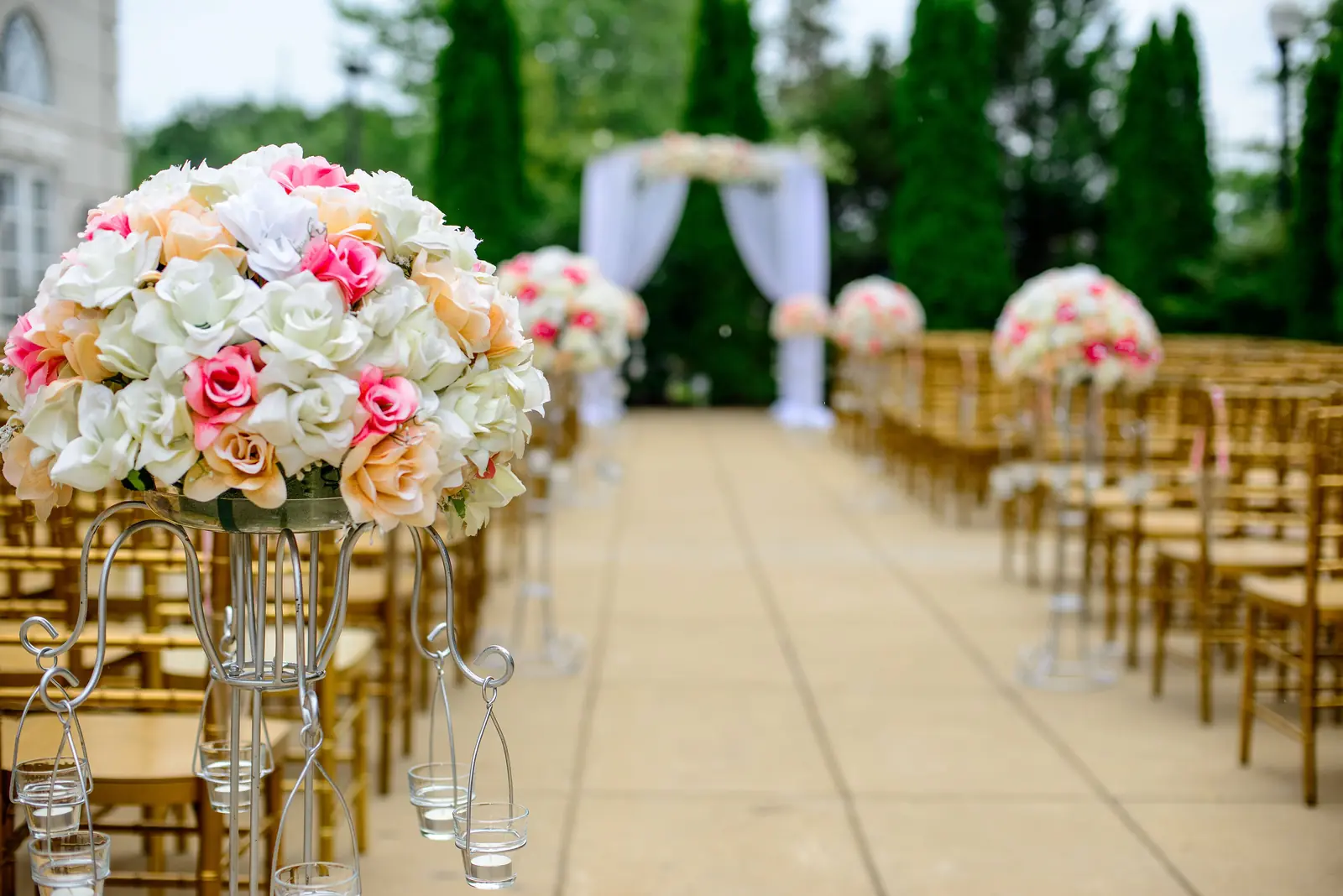
Every venue has its version of the showround. The fire is lit, the candles are on, and the coordinator knows exactly where to pause so you catch the view down the lawn. It works, and it should: you are choosing where to spend one of the best days of your life. But the things that shape that day are rarely on the tour: they live in the booking terms, the supplier rules and the registrars’ diary.
Take the same questions to every venue and write the answers down before you leave. By the third visit the rooms blur, and a page of answers side by side beats any number of photos on your phone.
Can you marry here, or celebrate here?
Start with the question that decides everything else. In England and Wales a civil wedding or civil partnership takes place either at a register office or in a building the local council has approved for ceremonies. Plenty of beautiful wedding venues have no approval at all: they host the party, and the legal part happens somewhere else earlier in the day. That suits some couples and surprises others, generally once the deposit has gone.
Every one of the more than 7,300 venues on this site holds that approval. Search the map by postcode or town to see what is near you, or browse by council area. If you are thinking of a church or another place of worship, different rules apply, and the places of worship page explains them.
Approval belongs to particular rooms, not to the whole estate. Ask which rooms are approved for ceremonies and how many people each one seats. Ask, too, whether the approval covers your date: councils approve a venue for three years at a time, and a well-run venue renews in good time.
If you want to marry outside
Outdoor civil ceremonies have been allowed since 2021, and the change was made permanent in 2022. The rules are narrower than wedding photos on social media suggest. The ceremony has to happen in the grounds of the approved building, inside the venue’s own boundary. The meadow next door, the woods beyond the fence and the beach below the cliff are not part of it, however close they look.
Venues do not have to offer outdoor ceremonies, and the registrars have to be satisfied that the spot is, in the official phrase, “seemly and dignified”. Ask to stand where the ceremony would happen, and ask what the indoor alternative is.
Two rules that shape the ceremony room
A civil ceremony cannot include anything religious: no hymns and no readings from the Bible or the Torah, though poems, songs and music are welcome. And no food or drink can be served or consumed in the ceremony room for an hour before the ceremony or during it. That second rule is why the drinks reception usually happens in another room, and why it is worth asking where your guests go while the room is turned around for dinner.
Who marries you, and how to book them
A civil ceremony is conducted by registrars from the registration service of the council that approved the venue. That is not always your own council: a couple from Bristol marrying in Cornwall books Cornwall’s registrars, and every venue on the map names the council that approved it.
The registrars are booked separately, and the venue cannot book them for you. The usual advice is to hold the date provisionally with the venue, check the registrars have someone free, then confirm both, so ask whether the venue will hold a date for a few days. On a summer Saturday the registrars’ diary can be the tighter of the two, and with several ceremonies to reach, their route decides which times they can offer you.
Separately, you each give notice of the marriage or civil partnership at the register office where you live, naming this venue. That is why the venue needs to be settled first: councils point out that changing venue after notice means giving notice all over again. The guide to wedding law covers notice and the rest of the legal side in more depth.
If a celebrant is leading your ceremony
Humanist and independent celebrant ceremonies are not yet legally binding in England and Wales. Couples who want one usually hold a short legal ceremony at a register office, then the ceremony that feels like the wedding at the venue. Because that ceremony is not the legal one, it needs no approved room, which opens up the orchard or the lake shore. Ask whether the venue hosts celebrant ceremonies, and where.
Yours alone, or shared?
“Exclusive use” means different things at different venues. At one it is the whole house and grounds from breakfast until the next morning. At another it covers your rooms while hotel guests or visitors share the rest. Ask exactly which spaces are yours, and for which hours.
Then ask whether there is another wedding the same day, or the same weekend. Two in one day means staggered timings and shared corridors. One booked for the next morning means your clear-down happens at midnight, not over a slow breakfast. And if the day before yours is free, ask whether your suppliers can set up then.
One thing no amount of exclusivity changes: the law requires a civil ceremony on approved premises to be open to the public, free of charge. Uninvited guests are vanishingly rare, but the doors cannot be locked for the ceremony itself.
Three numbers, not one
A venue’s headline capacity is its biggest room at its fullest. What you need is three numbers: how many the ceremony room seats, how many the dining room seats for the wedding breakfast, and how many the venue holds in the evening. They can be wildly different, and the smallest one matters most, because everyone invited to the ceremony has to fit into that room at once.
Ask whether there is a minimum number of guests, where the band sets up, and whether the dance floor comes out of the dining room or has a space of its own.
What is included
Here two venues that look alike on paper turn out very different. Does the booking include tables, chairs, linen, crockery, a cake stand and knife, a microphone for speeches, and staff to set up and clear? Is a coordinator there on the day, and do they stay to the end? Ask for the full price in writing, with a list of everything not included, so you compare like with like.
The rules on suppliers, sound and sparkle
Many venues work from a preferred-supplier list. Find out whether it is a friendly suggestion or a requirement, especially for the catering, the bar and the band, because a compulsory caterer decides your menu and your drinks. If you want to bring your own wine or champagne, ask whether the venue allows it and how corkage is charged, and get the answer in writing.
Then ask about sound. Most venues set a time for the music to stop, and some have a noise limiter that cuts the power when the volume passes a set level, which comes as a shock to a band in the middle of a chorus. Ask what the limit is, when the last song has to finish and when guests must leave. Pass it all to your band or DJ before you book them; the wedding planning timeline covers what else to ask.
Next come the details that end up in the photographs. Real candles, or LED? Confetti, and must it be biodegradable? Sparklers for the send-off, or a drone for aerial shots? The rules come from fire safety, insurance or the neighbours, and it is better to know before your florist orders forty pillar candles.
Ask, too, what the venue needs from your suppliers. Many ask for proof of public liability insurance, and electrical safety certificates for anything a band or DJ plugs in. Get the list in writing and send it to everyone you book.
Getting everyone there, and to bed
Walk the route a guest in a wheelchair, a grandparent with a stick or a parent with a pushchair would take. Is there step-free access to the ceremony room, the dining room and the toilets, an accessible toilet, and a lift if dinner is upstairs? Venues that host weddings every week have good answers ready, and hesitation tells you something too.
Ask how many bedrooms there are on site, whether you are expected to take all of them, and which hotels are nearby. Find out where you will get ready, from what time, and whether the people getting ready with you can use the same space.
Parking matters more than it sounds. How many spaces are there, and can guests leave cars overnight and take a taxi home? In the countryside, ask which taxi firms know the venue and how far ahead they need booking for the end of the night.
When the weather has other ideas
A British summer makes no promises, and the government’s own guidance tells venues offering outdoor ceremonies to plan for bad weather. Ask to see the wet-weather plan, not hear about it. Where does the ceremony move to, is that room approved, and does it seat everyone? Where do the drinks, the group photos and the confetti happen? Who makes the call on the day, and by what time?
A venue with a confident answer has a room it is proud of on grey days. A venue that tells you it never rains on its weddings is telling you something else.
The shape of the day
Ask the coordinator to walk you through a typical wedding timetable: when suppliers can get in, the ceremony slot, the gap before the meal, how long the room takes to turn around, when evening guests arrive and when the building must be clear. Pin this down early and the running order you write later is a matter of filling in names, which the planning timeline walks through.
Before you sign
Read the contract slowly, and ask about anything you could not explain to a friend. The questions worth asking:
- What is the payment schedule, and is the deposit refundable?
- What do you lose if you cancel, and does that change as the date gets closer?
- Can you move the date instead of cancelling, and on what terms?
- Is the price fixed now, or can it rise between booking and the wedding?
- What happens if the venue has to cancel, closes or changes hands?
- Is everything promised on the showround written into the contract?
That last one matters most. The coordinator who said the band could play until one is not always the person on duty on the day. Wedding insurance is worth a look alongside the contract, because it covers some of what a venue’s cancellation terms do not.
And before you decide, go back once at the time of day you would marry. Sit in the ceremony room, listen to how it sounds, and see where the light falls. The questions tell you whether a venue can host your wedding. That visit tells you whether you want it to.